

This is part 2 of an article. If you want to read part 1 click “Large does not always mean better: advice on choosing pot size – Part 1“
In order to create the perfect garden pot focal point or feature, everything about it needs to be right. This requires a number of different elements to be considered, with the 3 main ones being addressed in part 1 of this article. They are: Practical aspects, Spatial positioning and awareness, and Chosen planting. Of course it is possible to not have everything just right, but we are firm believers in trying (perhaps a reason why we drove all round Italy trying to find the perfect Terracotta manufacturers all those years ago – About us). To help with this process, we have come up with something, we feel, is rather handy…
Yes you read that right, we have created a Venn diagram to help in your choosing of the right size pot – it is actually more effective than you would at first think.
Within the diagram are the 3 points to consider, with the goal being the ultimate perfect pot size in the middle. If you find that you only have 2 out of the 3 points, then here is some help advice on what you could in each conundrum.

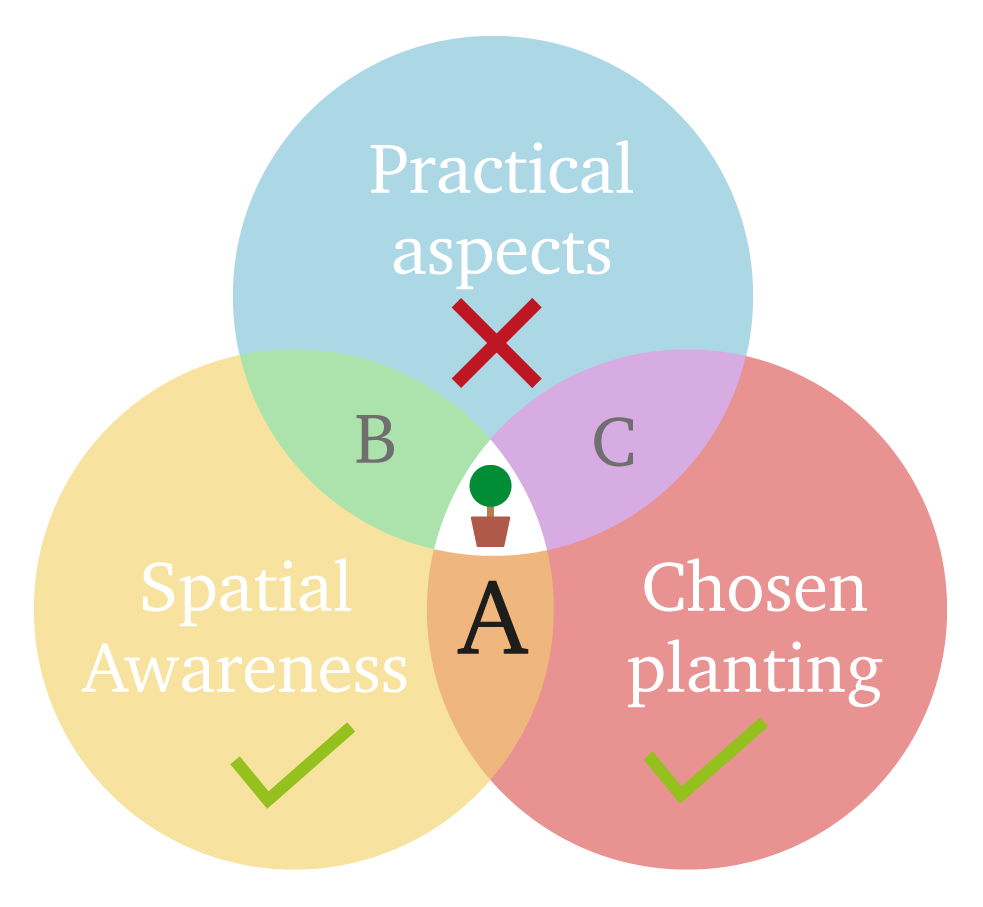
Perhaps the most frustrating: Your chosen pot would look right in it’s setting and works perfectly with your chosen planting, HOWEVER you don’t have access/the ability to get the pot in to it’s final location = Obvious one, but this is simply a no-go – back to the drawing board. You can only choose the size of pot that you can actually fit.
Just because you have to go smaller doesn’t mean you to the lose out on impact. Simple tricks can be used to make a pot appear larger than it actually is:
– Move the pot further away from walls or other things surrounding it. This can help distort the impression of scale, much like the technique of Forced Perspective.
– Same applies with choosing smaller plants, this can help make the pot appear larger. It does not necessarily mean a total change of planting as there are often smaller sized varieties within the same species of plant.
From the most frustrating to possibly the simplest to sort – You have access, would look perfect in it’s location, however the planting would not work with it = No. If the chosen planting will not look right then it wouldn’t matter how clever you have been with choosing the right size pot or the perfect location, the overall impression given by the pot and planting together as a whole will ruin it.
The easiest thing to try first is to see if there are smaller or larger varieties of your chosen plants available. As mentioned in Conundrum A, this then doesn’t have to mean a complete change to your planned visual aesthetic. If this is not possible, and for some reason, such as the purpose of the planting, or the already existing surrounding planting, you can’t change, then perhaps look at a smaller pot, or a different style (eg, taller, wider, narrower, etc). It is better that everything works in harmony than to be initially headstrong and have the end result fail.
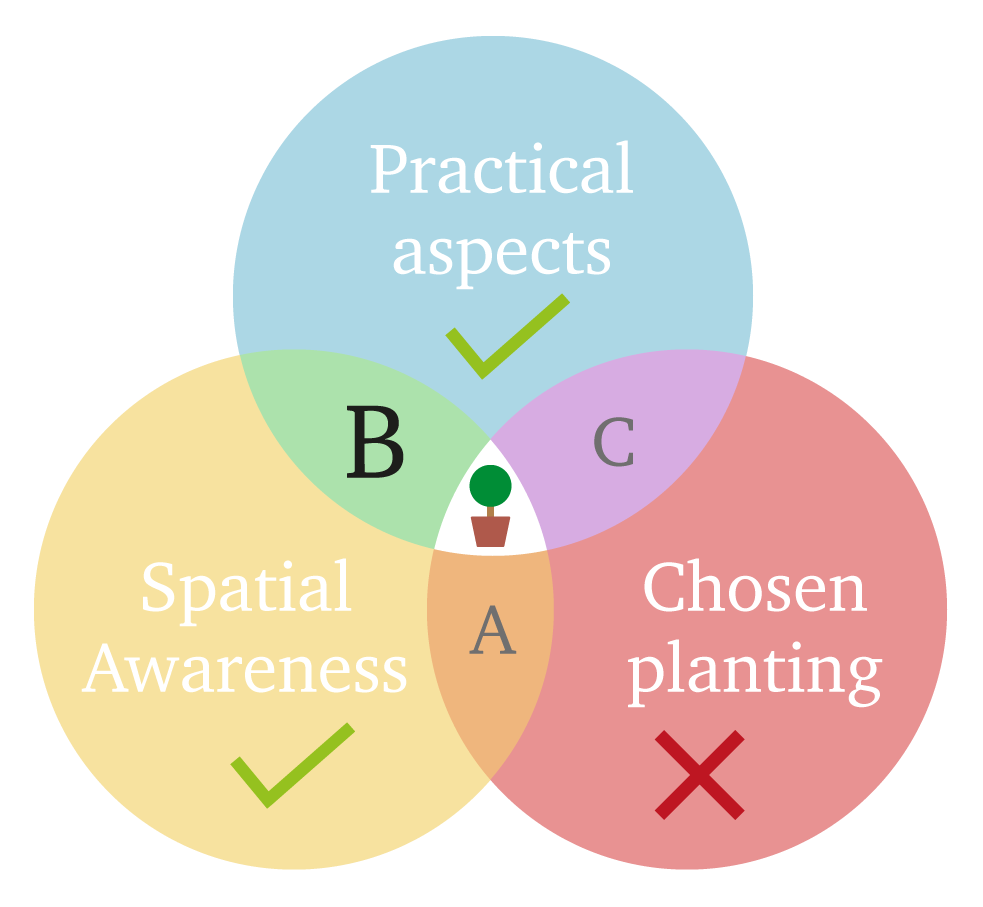

You have the access, would work with the planting you’ve chosen, but aesthetically would not work in it’s surroundings = No! If for whatever reason the end result would look wrong, then there is no point in doing it. The pride in having chosen the largest pot possible will soon be forgotten when you are faced forever with a vista that is not pleasing to the eye.
What smaller size pot would work best? Perhaps a group or a theatre of pots would work better? Perhaps think about the 2 previous mentioned techniques in Conundrum A. Don’t forget the flat-backed and corner pots – we purposefully created some of our pots with these features so that the desired pot can still be used even when the full round version may not suit or work in the desired location.
We have advised this tip to clients a lot over the years and the feedback has been that it has been very beneficial: Try and find an object that is roughly the same scale as the pot size you are thinking of choosing and put it in the desired location. Live with it for a while to see what you think to its scale, impact, and practicality. Reading a set of dimensions on paper/screen can really not impress upon you the shear bulk and imposing impact that the pots have when actually in front of you; something that may seem right on paper may just seem too much when you are actually faced with it. By trying the tip of using temporary objects to get a sense of scale and practical apsects, you can potentially be saved either a lot of time of having to return and reorder pots, or a lifetime of the feature not ever looking right.
We hope this has helped you when considering what size pot to choose. If you have any questions or would like more advice, of any sort, please do not hesitate to contact us.